History Behind Taj Mahal
The Eternal Love of Shah Jahan and Mumtaz Mahal
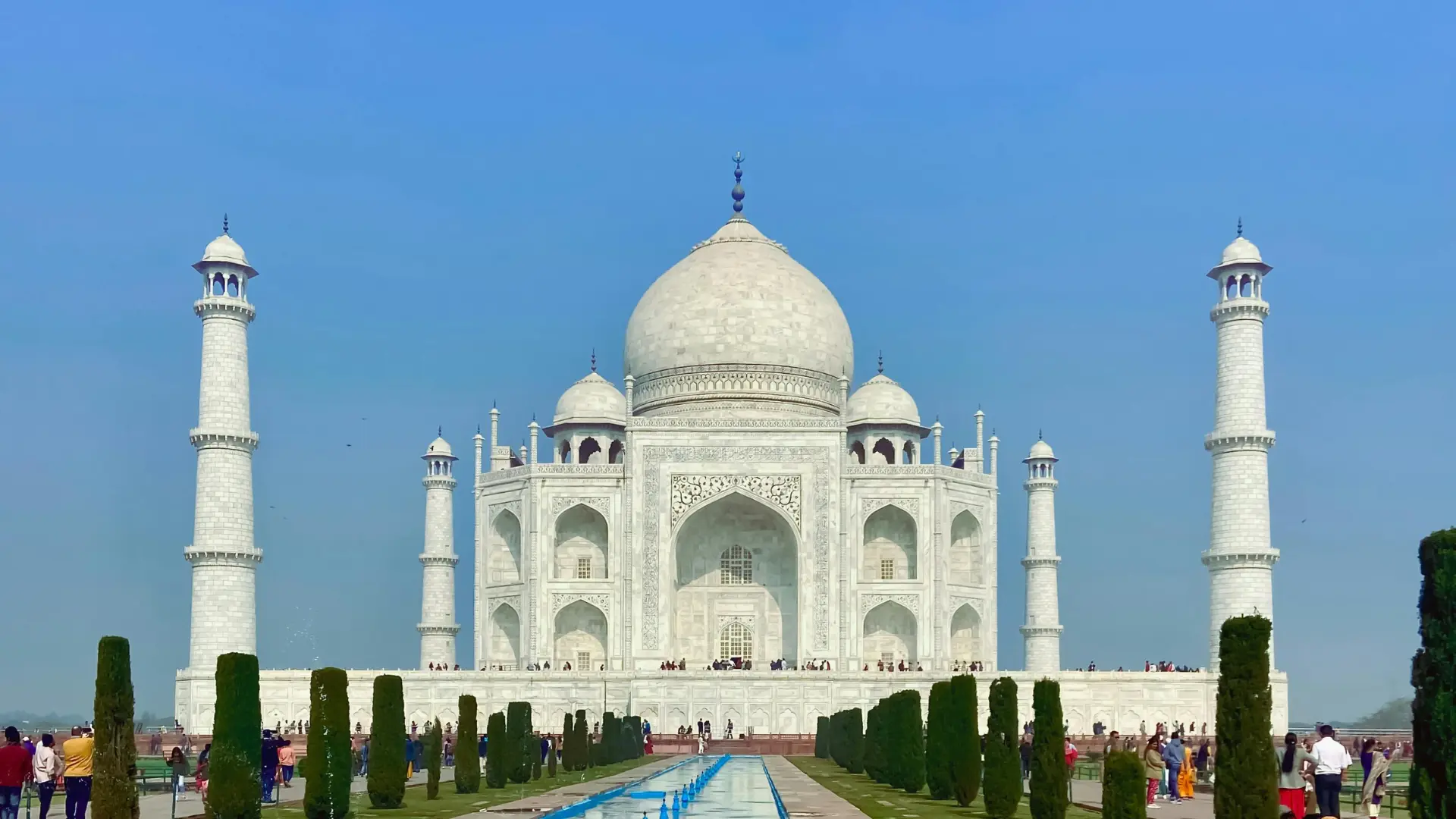
The Taj Mahal in Agra was commissioned by the Mughal emperor Shah Jahan in memory of his favourite wife, Mumtaz Mahal, who died in childbirth in 1631.
Their union had begun in 1612 and Mumtaz Mahal had accompanied Shah Jahan on military campaigns, before her untimely death.
The Taj Mahal thus stands as both a funerary monument and an expression of imperial love and loss.
Construction Timeline: From 1631 to 1653
Construction is generally said to have begun around 1632.
According to the UNESCO World Heritage listing the main mausoleum was essentially completed by 1648, with the surrounding complex finalised by about 1653.
During this time, more than 20,000 (often cited ~20,000-22,000) workers and artisans were involved in the project.
Thus the building spanned roughly 20-22 years of construction.
Legends and Historical Events Around Its Creation
One enduring legend is that Shah Jahan intended to build a “Black Taj” on the opposite bank of the Yamuna River, made of black marble, as his own tomb — but was deposed by his son Aurangzeb before it was realised.
Another historical note: after his deposition, Shah Jahan reportedly spent his last years under house-arrest in the neighbouring Agra Fort, where he could gaze upon the Taj Mahal.
Such stories contribute to the rich tapestry of myth, history and legacy that surrounds the monument.
Why Agra Was Chosen as the Site of the Taj Mahal
The Taj Mahal is located in the city of Agra in Uttar Pradesh, India, on the southern (right) bank of the Yamuna River.
Agra was a major Mughal capital and thus a fitting site for an imperial monument of this scale.
The riverside location allowed the building’s reflection in the garden water-channels and emphasised its grandeur in the Mughal landscape.
The Architectural Blend: Persian, Islamic & Indian Influences
The Taj Mahal is widely regarded as the finest example of Mughal architecture, which synthesises Indian, Persian and Islamic design elements.
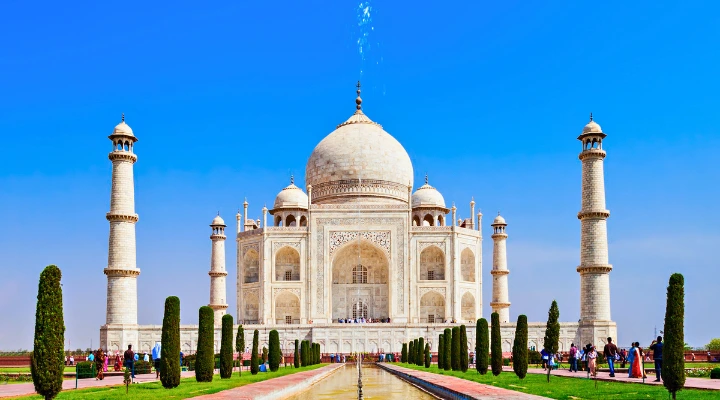
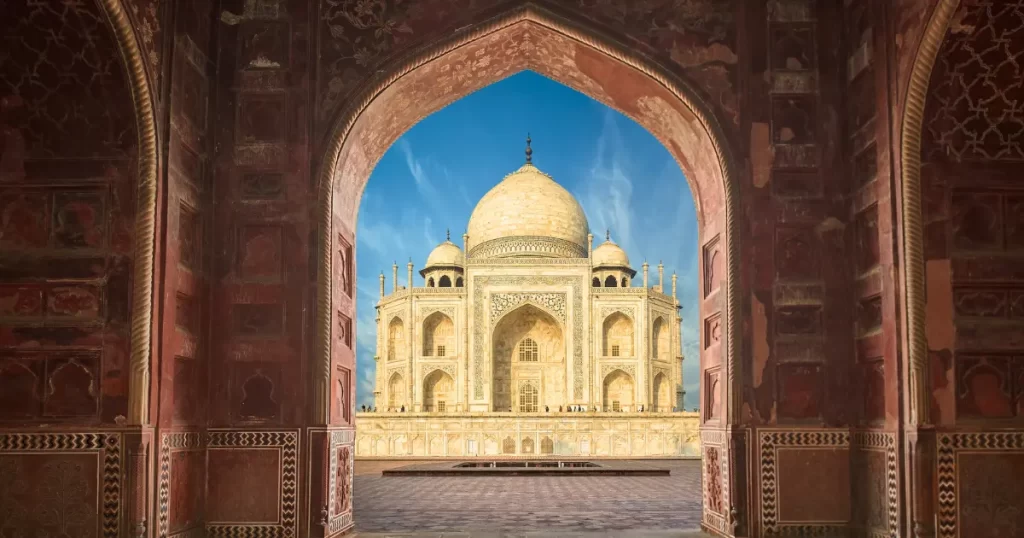
Its core features — the large white marble dome, the four minarets, the mausoleum with its symmetrical façades, the charbagh (four-part) garden layout – reflect this blend of styles.
For example, the garden layout draws on Persian Islamic paradigms, while the decorative inlay work and calligraphy reflect the Indo-Islamic artistry of the Mughal era.
Materials Used – White Marble, Gem Inlays, and Engineering Precision
The main mausoleum is clad in white marble from Makrana in Rajasthan.
An extensive array of semi-precious stones — including lapis lazuli, jade, turquoise, jasper, onyx and others — were inlaid into the marble surfaces for decoration (technique known as “pietra dura” or “parchin kari”).
Engineering innovations include the four minarets which are built slightly leaning outward so that in the event of collapse (e.g., earthquake) they would fall away from the central tomb.
Symbolism, Design & Cultural Significance
The Taj Mahal as a Monument of Eternal Love
While a tomb, the Taj Mahal is also viewed as an architectural symbol of Shah Jahan’s enduring love for Mumtaz Mahal. The legend and narrative of their story elevate it as more than a structure — a memorial and masterpiece.
At the same time, it functions as an imperial monument: a demonstration of the emperor’s power, resources and aspiration to craft an eternal legacy.
Meaning Behind the Perfect Symmetry and Charbagh Gardens
The entire complex is organised along a strong axial and symmetrical design. The charbagh garden is divided into four quarters by walkways and water-channels, which in Islamic garden symbolism represent paradise.
The mausoleum itself is perfectly squared with chambers and corners symmetrically laid out; the design emphasises balance, harmony and order — key values in Mughal architecture.
These features reinforce the spiritual and symbolic intent of the monument: to represent paradise on earth, idealised beauty and eternal rest.
Myths, Colour Changes, and Symbolic Elements of the Design
One well-known “fact” is that the Taj appears to change colour: soft pink at dawn, brilliant white in daylight, golden under moonlight.
Optical illusions are part of its design: for example, the outward-tilting minarets create the illusion of perfect uprightness while offering structural protection.
Visiting Tips - Best Time, Entry Rules, and Must-See Views
Best time: early morning at sunrise offers softer light, fewer crowds; also evening light can be magical.
Entry guidelines: Separate ticketing for Indian and foreign nationals; modest dress recommended; shoe covering inside the mausoleum.
Must-see views: the front reflecting pool for full façade views; the river-bank view across the Yamuna; inside the mausoleum to see the cenotaphs and subtle inlay details.
For more information, connect with us at: +91 81301 89131